The global architecture, engineering, and construction (AEC) industry is at a critical inflection point. For decades, it has faced persistent challenges of low productivity, frequent cost overruns, significant material waste, and a large environmental footprint. In response, two transformative paradigms have emerged as the twin pillars of a modern, industrialized solution: Building Information Modeling (BIM) and Prefabrication.
BIM represents the industry’s digital transformation, offering a collaborative, data-rich digital model. It directly addresses the information fragmentation that plagues traditional projects. Prefabrication, in contrast, represents the industry’s industrialization. By moving construction activities into a controlled factory, it tackles the physical and logistical fragmentation of on-site work.
However, their true power is not just in their parallel use. The integration of BIM and prefabrication creates a powerful, symbiotic relationship. This synergy creates a seamless, digitally-driven workflow that optimizes the entire project lifecycle, from the first design sketch to the final on-site assembly. This post explores this powerful synergy, analyzing its processes, quantifiable impacts, implementation challenges, and the future it promises for a more efficient industry.
Understanding the Core Concepts: What Are BIM and Prefabrication?
Before diving into their integration, it’s essential to understand each concept on its own. Together, they represent the shift from fragmented information and physical work to a unified cyber-physical system.
BIM: The Digital Blueprint for Modern Construction
Building Information Modeling (BIM) has evolved far beyond simple 3D modeling. The international standard ISO 19650-1:2018 defines BIM as the “use of a shared digital representation of a built asset to facilitate design, construction and operation processes to form a reliable basis for decisions.” In simple terms, BIM is a process, not just a piece of software.
At its core, BIM creates a centralized “single source of truth.” This data-rich model contains intelligent objects, each with its geometry, relationships, and attributes, such as material properties and cost data. Consequently, it breaks down the traditional information silos. When an engineer moves a structural column in the model, the architect and contractor see the change instantly. This real-time collaboration drastically reduces the coordination errors and rework common in traditional 2D-drawing workflows.
Furthermore, the power of BIM extends beyond 3D:
- 4D BIM adds the dimension of time. By linking the 3D model to a schedule, teams can create dynamic simulations of the construction sequence, identifying logistical problems before they happen.
- 5D BIM integrates the dimension of cost. As the model contains precise material quantities, 5D BIM enables highly accurate, automated cost estimation and real-time budget tracking.
- Further Dimensions (6D & 7D) extend this data into the asset’s full lifecycle. 6D BIM often relates to sustainability, allowing for energy performance simulations. 7D BIM, meanwhile, focuses on facility management, embedding maintenance schedules and warranty data into the model for the building’s operator.
Prefabrication: Building the Future in a Factory
Prefabrication, also known as Off-Site Construction (OSC), is the practice of assembling building components in a factory. These completed assemblies are then transported to the construction site for final installation. This method inverts the traditional process. Instead of bringing raw materials to a chaotic site, prefabrication manufactures large-scale components concurrently in a controlled environment.
Prefabrication exists on a spectrum of methods:
- Component-Based: This is the most common form. It involves manufacturing individual elements like pre-cast concrete panels, floor slabs, or steel frames.
- Panelized Systems: This method involves producing flat, 2D units, such as exterior walls or floor cassettes. These panels may even include insulation, cladding, and windows.
- Modular (Volumetric) Construction: This is the most advanced level. It involves manufacturing complete 3D “modules,” such as entire rooms, that are fully finished with plumbing, electrical, and fixtures in the factory.
- Hybrid Systems: Many modern projects use a hybrid approach, combining volumetric modules for bathrooms with panelized systems for walls, for example.
The Power of Synergy: How BIM and Prefabrication Work Together
The true transformation happens when BIM and prefabrication are integrated. This integration creates a seamless, data-driven workflow that connects digital design intent directly to physical manufacturing. BIM acts as the digital backbone for the entire prefabrication value chain.
This approach fundamentally “front-loads” project effort. It shifts critical problem-solving from the expensive and chaotic construction phase to the controlled, digital pre-construction phase. Instead of finding a physical clash on-site, teams resolve a digital clash in the model. As a result, project risk is dramatically reduced.
Design and DfMA: The BIM and Prefabrication Starting Point
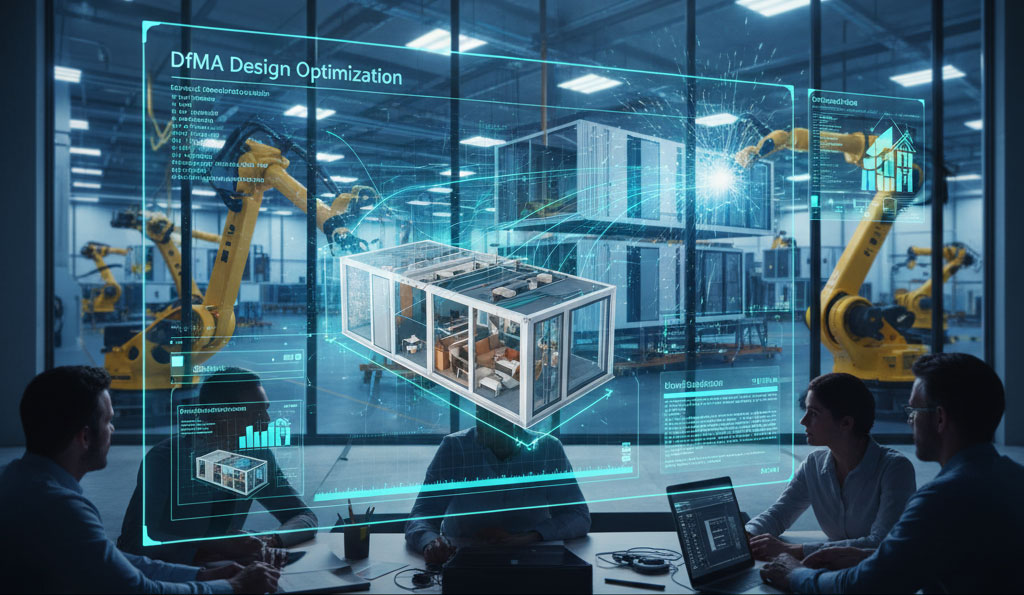
The design phase for an integrated project is guided by Design for Manufacture and Assembly (DfMA). This philosophy prioritizes the ease of manufacturing components and the efficiency of their on-site assembly.
BIM is the cornerstone technology for DfMA. It provides the precise, information-rich environment needed to coordinate complex components and optimize designs for a factory workflow. One of BIM’s most powerful tools here is automated clash detection. The software analyzes the 3D model and identifies any place where components—like a pipe and a duct—are trying to occupy the same space. In traditional construction, teams often discover these conflicts on-site, leading to costly delays and rework. With BIM, teams resolve these clashes digitally before a single component is built.
From Digital to Physical: BIM and Prefabrication in Manufacturing
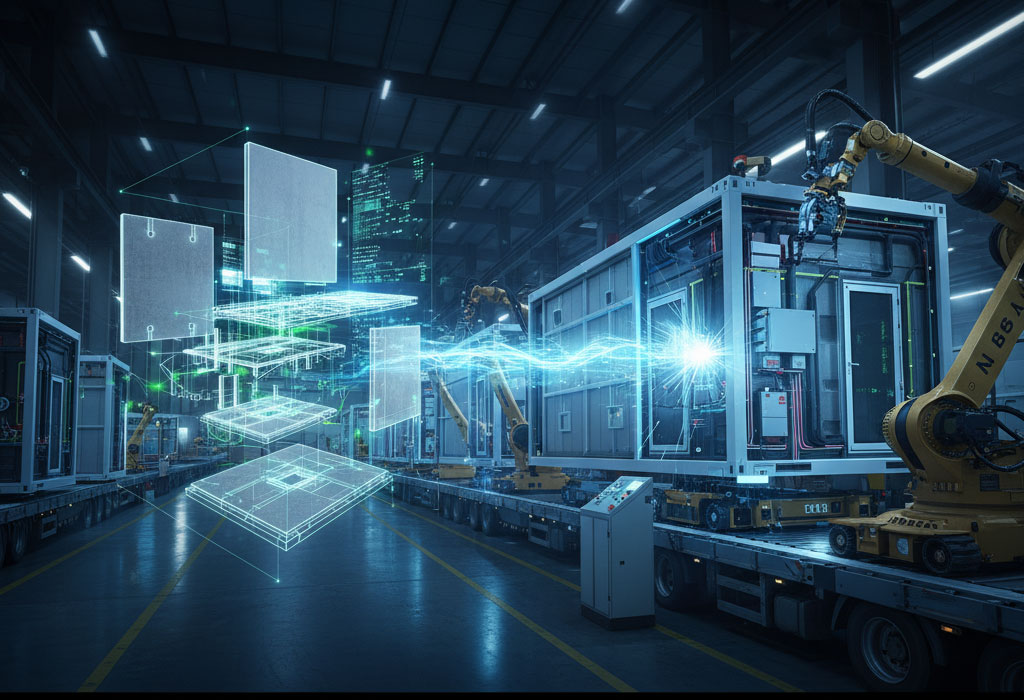
Once the design is finalized, the BIM model becomes the direct instruction set for production. This enables a “digital-to-production” workflow. The rich data within the BIM model can be exported directly to Computer-Numerically Controlled (CNC) machines and robotic fabrication systems. These automated systems then produce the components with immense precision, minimizing human error and maximizing efficiency.
In the factory, BIM continues to act as the central source of truth. Production teams can access the 3D model to visualize complex assemblies and confirm specifications. This ensures everyone is working from the latest approved design, which is essential for high-quality control.
Smart Logistics: Using BIM and Prefabrication for Supply Chain Control
A prefabricated project depends on the precise coordination of a complex supply chain. Here again, BIM provides the necessary digital tools.
Using 4D BIM, project teams can create detailed simulations of the entire logistics sequence. They can visualize exactly when each component must be manufactured, shipped, and delivered to align with the on-site assembly plan. This data-driven platform is a key enabler of Just-in-Time (JIT) delivery. Consequently, components arrive exactly when needed, minimizing on-site storage, reducing inventory costs, and preventing damage.
Precision On-Site: Assembling the BIM and Prefabrication Project
Finally, the assembly crew on-site uses the BIM model as a visual instruction manual. Instead of interpreting complex 2D drawings, workers can view 4D animations of the assembly sequence. This visual clarity reduces ambiguity, minimizes installation errors, and dramatically improves the speed of on-site operations.
This virtual environment is also a powerful tool for proactive safety planning. Teams can simulate high-risk activities, like complex crane lifts, in the 4D model. They can check for clearance issues, identify hazards, and plan safe exclusion zones. This ability to rehearse and de-risk operations in a virtual world significantly improves project safety.
The Quantifiable Gains of Integrating BIM and Prefabrication
The benefits of this integrated approach are not theoretical. A wide range of case studies and analyses consistently document profound gains in efficiency, sustainability, and quality.
Economic Wins: How BIM and Prefabrication Save Time and Money
The most dramatic improvements are in project cost and schedule. Prefabrication’s parallel processing—building in the factory while preparing the site—is a primary driver of schedule reduction. Research consistently finds that modular and prefabricated construction can reduce project schedules by 20% to 50%. For example, a hospital project in Norway cut its construction time by 30%, while a multifamily building in Rio de Janeiro documented a 40% reduction in project duration.
The cost savings are equally significant. By eliminating on-site rework through digital clash detection, optimizing material use in a factory, and reducing on-site labor hours, this approach drives down budgets. A case study of a residential unit, for instance, demonstrated overall construction cost savings of up to 18%. Another analysis of projects using a collaborative BIM-centric model found they finished, on average, 6% under budget.
Environmental Impact: A Greener Footprint with BIM and Prefabrication
The synergy between BIM and prefabrication offers a powerful pathway to sustainable construction. Material waste reduction is one of the most significant benefits. BIM enables precise material quantity take-offs, while the factory environment allows for efficient recycling of scrap. As a result, studies show that prefabrication can reduce overall construction waste by at least 50%. In fact, some projects in Hong Kong have reported on-site waste reductions as high as 84.7%.
Furthermore, BIM’s capacity for energy performance analysis during the design phase is a key driver of efficiency. Architects can simulate solar exposure and thermal performance to optimize the design for lower operational energy consumption. Projects using this workflow have demonstrated a 55% to 75% reduction in operational energy use. This integrated approach also reduces a building’s physical weight. The multifamily building in Rio, for example, achieved an 89% reduction in structural weight by switching from concrete to a prefabricated steel-frame system, which in turn required a smaller, less resource-intensive foundation.
Better Quality and Safety: The Human Benefits of BIM and Prefabrication
Beyond the numbers, the qualitative benefits are transformative. Manufacturing components in a controlled factory inherently leads to a higher, more consistent level of quality, shielded from weather and subject to rigorous quality checks.
This approach also significantly improves worker safety. First, it physically transfers labor hours from the hazardous outdoor site to a safer, controlled factory environment. Second, the ability to digitally simulate and plan high-risk activities in BIM helps mitigate hazards before they occur.
Moreover, this modern method has a profound positive impact on worker well-being. The factory environment offers more stable, ergonomic working conditions and regular hours. A 2023 study found that workers in prefabricated construction reported significantly less mental fatigue, work overload, and poor work-life balance. This improved work environment directly translates to higher job satisfaction and better mental health, addressing a critical social sustainability issue in the industry.

Overcoming the Obstacles: Challenges for BIM and Prefabrication Adoption
Despite these compelling benefits, widespread adoption of integrated BIM and prefabrication remains inconsistent. Systemic and interconnected barriers reinforce the status quo and slow this transformation.
Technical and Financial Barriers to BIM and Prefabrication
On the technical side, a primary hurdle is the lack of true software interoperability. Architects, engineers, and fabricators often use different software, and exchanging complex data between them can lead to data loss and errors. This undermines the “single source of truth” principle. Closely related is the lack of universally enforced standards for BIM data and component libraries, which makes automation difficult.
Financially, the high initial cost of BIM implementation—including software, hardware, and extensive training—is the most cited barrier. This is especially challenging for small and medium-sized firms. This problem is compounded by the difficulty in calculating a clear, immediate Return on Investment (ROI), as many benefits (like reduced rework or lower operational costs) are hard to quantify upfront.
Cultural and Contractual Hurdles for BIM and Prefabrication
Perhaps the most formidable barriers are human. The construction industry is notoriously resistant to change. Adopting BIM and prefabrication requires a fundamental cultural shift from a linear, often adversarial process to a highly collaborative and integrated one. This demands a new mindset and a willingness to share information freely.
This cultural resistance is linked to a significant skills shortage. There is a widespread lack of professionals who can effectively manage these complex, integrated digital workflows. Finally, traditional construction contracts, like Design-Bid-Build, are poorly suited for this new model. They create rigid silos and prevent the early involvement of manufacturers, which is critical for a successful DfMA process.
Overcoming these barriers requires a holistic approach, including policy incentives, industry-wide training, and new contractual frameworks that support early collaboration.
The Next Frontier for BIM and Prefabrication
The integration of BIM and prefabrication is only the beginning. The next frontier is the convergence of this framework with a new wave of emerging technologies that promise a fully automated, intelligent, and interconnected construction ecosystem.
AI, Digital Twins, and the Future of BIM and Prefabrication
Artificial Intelligence (AI) is already enhancing BIM. AI-powered generative design algorithms can autonomously explore thousands of design options to find the optimal solution that meets all constraints, from structural requirements to manufacturing limitations.
The true evolution of BIM, however, is the Digital Twin (DT). While a BIM model is largely static, a Digital Twin is a living virtual replica of the physical building. It is continuously updated with real-time data from sensors throughout the asset’s entire operational life. This allows owners to monitor performance, predict maintenance needs before failures occur, and optimize energy use in real-time.
An Automated Future: IoT, Robotics, and Blockchain in Construction
Several other technologies are completing this cyber-physical system.
- The Internet of Things (IoT) provides the “nervous system.” Sensors on components, in transit, and on-site feed real-time data (like location, temperature, or stress) back into the Digital Twin.
- Robotics provides the “muscle.” The precise data from the BIM model can directly program robotic systems to automate fabrication and assembly tasks, from welding steel frames to 3D printing complex components.
- Blockchain technology offers a potential solution for trust and transparency. It can create an unchangeable, secure record of a component’s journey or automate payments through “smart contracts” that execute when a component is successfully installed.
This ultimate vision is a closed-loop system where an AI manages a central Digital Twin, IoT sensors provide real-time feedback, and robotic systems execute tasks autonomously. This represents the complete industrialization of construction, finally bringing the AEC industry in line with 21st-century advanced manufacturing.
Conclusion
The convergence of Building Information Modeling and Prefabrication is a definitive paradigm shift. It offers a validated, powerful solution to the construction industry’s oldest and most persistent challenges. The evidence is clear: this integrated approach delivers substantial, quantifiable benefits. It accelerates project schedules, reduces costs, minimizes material waste, and enhances environmental performance.
Furthermore, it delivers profound qualitative improvements. It results in higher-quality buildings, creates far safer work environments, and promotes better worker well-being.
To be sure, significant barriers remain. Technical, financial, and cultural hurdles still hinder widespread adoption. However, overcoming these challenges is not a matter of “if” but “when.” The overwhelming evidence of the benefits, combined with the relentless advance of enabling technologies like AI, Digital Twins, and robotics, confirms this trajectory.
The synergistic integration of BIM and prefabrication is no longer a speculative concept. It is the proven, viable, and most potent pathway toward a more efficient, sustainable, and productive future for the construction industry.